
Why Most Engineers Give Up Before They Grow
Understanding Creative Tension vs. Emotional Tension — A Systems Thinking Insight

“People don’t resist change. They resist being changed.”
— Peter Senge, The Fifth Discipline
In software engineering, most of us have faced this:
We set a goal to go deep into C++, understand operating systems, or make sense of legacy code.
We start strong.
We get stuck.
And then… we either back off or lower the bar.
What happened?
We didn’t lack intelligence or motivation.
We misunderstood the tension we were feeling.
Let me explain.
The Hidden Power of the Gap
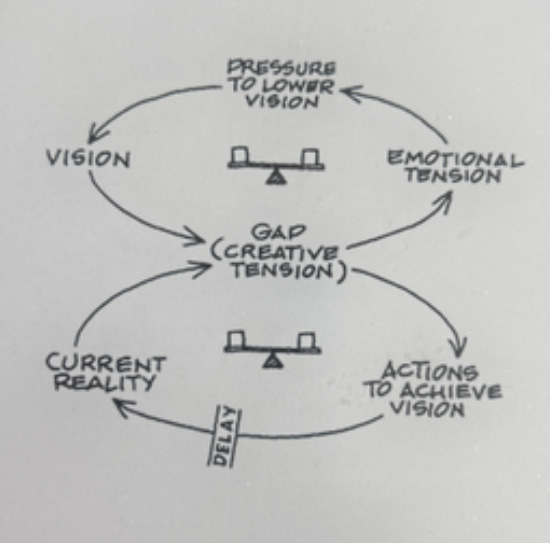
Peter Senge calls it Creative Tension.
It arises when there’s a gap between your current reality and your vision.
If your vision is to master low-level memory management in C++, and your current reality is being confused by smart pointers — you feel the gap.
This tension is good.
It’s motivating. It pulls you toward learning.
But here's the problem: we confuse it with Emotional Tension.
Creative Tension vs. Emotional Tension
Creative Tension comes from a meaningful gap — it pushes us to act.
Emotional Tension comes from discomfort — and pushes us to avoid the pain.
When emotional tension rises, people tend to:
Lower the vision: “Maybe understanding malloc internals is overkill.”
Give up: “This legacy code is a black box. Let it be.”
This is the moment where growth is lost.
The Trap of Delayed Feedback
The systems diagram from The Fifth Discipline highlights another piece:
Even when you take the right actions, the results don’t show up immediately.
You can:
Read 200 pages on kernel architecture,
Spend weeks tracking variable mutations across a 50k LOC codebase,
Write, refactor, debug, and repeat…
And still feel like you’re not getting anywhere.
That’s delay, and it feeds emotional tension.
Many engineers mistake this for failure — but in systems thinking, delay is expected. It’s not a bug. It’s how complex systems work.
What Can You Do?
Here’s how to use this insight as an engineer or tech lead:
✅ Normalize the gap: It means you care. It means you’re growing.
✅ Expect discomfort: Emotional tension will surface. Label it, don’t obey it.
✅ Measure progress differently: Instead of waiting for mastery, track tiny wins — “Today I understood this one macro.”
✅ Hold the vision: Especially when tempted to give it up. That’s the moment systems thinking starts to matter.
Final Thought
Whether you’re diving into memory alignment, OS schedulers, or legacy refactors —
The creative tension you feel is a signal of purpose, not pain.
Most engineers don’t burn out because the path is too hard.
They burn out because they mistake the emotional discomfort for a sign they’re not meant to walk it.
You are.
Keep walking.
🧠 If this resonated, consider subscribing. I write about systems thinking, developer growth, and engineering leadership — minus the fluff.