
The Four Developer Archetypes: Inspired by Linchpin by Seth Godin

I recently came across a simple but powerful 2x2 framework in Linchpin by Seth Godin. It maps human behavior along two axes: Passion vs. Passivity and Discernment vs. Attachment.
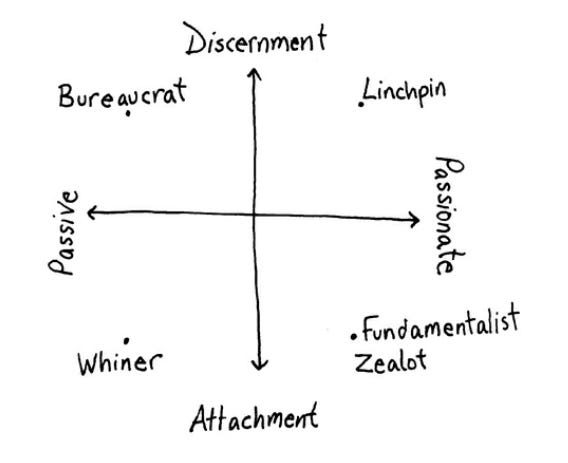
What struck me was how accurately this framework describes the types of software developers I’ve worked with.
Let’s break it down:
🧭 The Two Axes
Horizontal Axis: Passive ⟷ Passionate
Measures energy and initiative. Are you just going with the flow—or actively trying to improve things?Vertical Axis: Attachment ⟷ Discernment
Measures clarity of thought. Are you clinging to your biases—or making decisions based on context and value?
💡 The Four Quadrants of Developers
🗯 1. The Whiner (Passive + Attached)
Complains often, contributes rarely.
These developers highlight what’s broken, but stop short of actually fixing anything. They live in the past—often recounting stories of systems they built “the right way”—but resist involvement when a real opportunity for improvement arises.
Real example:
One developer kept complaining that our CI/CD pipeline lacked a pre-prod environment to catch issues earlier. It was a minor config change, but they didn’t want to own the fix. Instead, they repeated the same complaint across multiple retros.
Common behaviors:
Bring up problems but never volunteer for solutions.
Talk more about the past than the present.
Drop “suggestions” and disappear when action is needed.
🧾 2. The Bureaucrat (Passive + Discerning)
Understands systems, but uses them to hide.
Bureaucrats aren’t clueless—they know what needs to be done. But instead of stepping up, they use process, policies, or hierarchy as a shield to avoid action. Their mantra: “That’s not my responsibility.”
Real example:
We had an on-call engineer who would mark all unresolved bugs as "Cannot reproduce" just before their shift ended. This allowed them to report zero open issues—but meant that real bugs lingered unresolved for weeks.
Common behaviors:
Refuse to act unless a ticket exists.
Offload everything even slightly outside their "role."
Avoid stepping into ambiguity or ownership.
🔥 3. The Zealot (Passionate + Attached)
Deeply invested—but rigid and resistant to change.
Zealots care—but only if things go their way. They are emotionally tied to their toolchain, their language, their patterns. Progress becomes personal. They write code with passion but often for the wrong reasons.
Real example:
A backend engineer I worked with insisted that frontend coding isn't “real” coding. When asked to help, they'd push poor-quality, unreviewed code—rationalizing it with statements like “This is just UI stuff.”
Common behaviors:
Resist newer technologies or approaches unless it was their idea.
Dismiss other roles (QA, frontend, DevOps) as “less technical.”
Get emotionally reactive during reviews or debates.
🌟 4. The Linchpin (Passionate + Discerning)
Combines action with clarity. Quietly transforms teams.
Linchpins are rare—and priceless. They solve problems without drama. They see the big picture, take ownership, and elevate everyone around them. You’ll find them automating workflows, writing onboarding docs, or mentoring quietly.
Real example:
I worked with a developer who built small but powerful tools—like a code review checklist, provisioning scripts for dev VMs, and custom dotfiles with helpful command aliases. These small utilities massively improved developer productivity.
Common behaviors:
Solve instead of complain.
Create tools and systems that help others.
Are emotionally invested—but not egotistical.
🎯 Final Thought
Every team has all four archetypes. At times, we’ve all been one of them. But the magic lies in moving toward the Linchpin quadrant—not through pressure, but through growth and self-awareness.
Ask yourself:
Am I offering ideas and taking ownership?
Am I resisting change due to ego or clarity?
What can I do—today—that makes things better for my team?
Because teams don’t need more critics. They need more linchpins.