
How Agents Evolve with Large Language Models (LLMs): From Assistants to Autonomous Decision-Makers

While reading AI Agents in Action, I came across a powerful insight: the journey of AI systems — particularly LLMs like ChatGPT — is steadily moving from being simple question-answering tools to becoming sophisticated autonomous agents capable of acting on our behalf.
A visual framework I found (see image) captures this progression beautifully. In this blog post, I’ll break down this evolution across four stages, complete with explanations and examples, so you can better understand the future of human-AI collaboration.
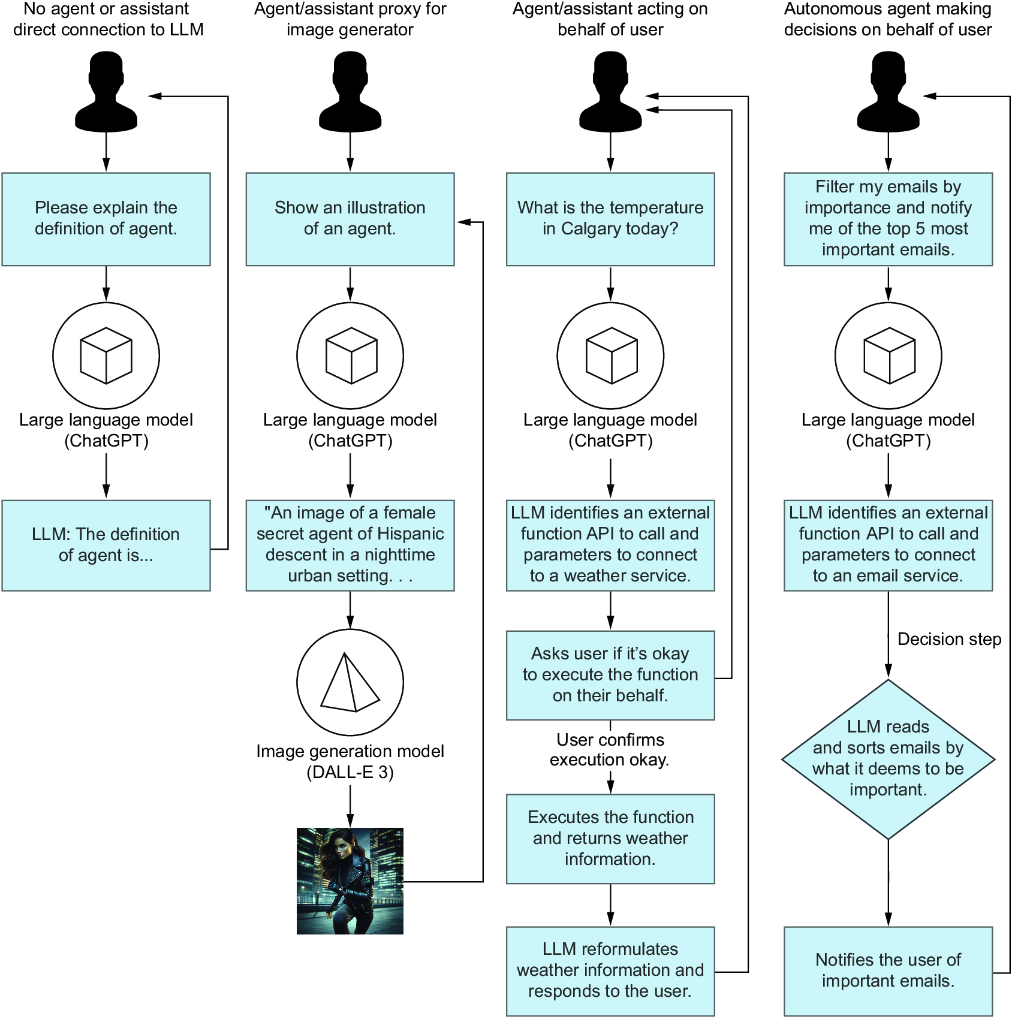
Source - AI Agents In Action
1. No Agent or Assistant — Direct Connection to the LLM
What Happens:
At this base level, the user interacts directly with the LLM. The model processes natural language input and generates responses based purely on its internal knowledge. There is no external data access, no execution of tasks, and no real-world interaction.
Example:
You ask,
"Please explain the definition of an agent."
The LLM (e.g., ChatGPT) responds:
"An agent is an entity capable of perceiving its environment through sensors and acting upon that environment through effectors to achieve goals."
It's a simple, closed-loop communication: ask → generate → reply.
There’s no calling APIs, no integrations, no decision-making beyond selecting the most relevant answer.
2. Agent/Assistant as Proxy for External Tools (e.g., Image Generation)
What Happens:
In this stage, the LLM acts as a proxy — a bridge between the user and an external system (like an image generator, database, or calculator). It formulates requests for the external system but still relies on the user for input and does not make decisions on its own.
Example:
You ask,
"Show an illustration of an agent."
ChatGPT responds by generating a descriptive prompt:
"An image of a female secret agent of Hispanic descent in a nighttime urban setting."
This description is passed to an external image model (like DALL-E 3), which creates the image and sends it back via ChatGPT.
Here, the LLM doesn’t "create" the image directly; it requests another system to perform the task based on your command.
3. Agent/Assistant Acting on Behalf of the User (with Permission)
What Happens:
At this more sophisticated level, the LLM identifies external actions needed to fulfill the user’s request — but crucially, asks for permission before taking those actions. The LLM essentially becomes a "semi-autonomous agent," acting on behalf of the user after gaining explicit approval.
Example:
You ask,
"What is the temperature in Calgary today?"
The LLM figures out that it needs to access a weather service. It prompts:
"Would you like me to fetch the latest temperature data for Calgary from a weather API?"
Upon your confirmation, the LLM calls the weather API, retrieves the data, interprets it into a readable response, and shares the information with you.
Here, it’s planning and executing tasks, but respecting user control at every step.
4. Autonomous Agent Making Decisions on Behalf of the User
What Happens:
This is the most advanced and transformative stage.
The LLM becomes a fully autonomous agent — able to take actions, access external services, make judgments, and complete tasks without constant user intervention. It is trusted to make certain decisions based on user preferences or prior authorization.
Example:
You say,
"Filter my emails by importance and notify me of the top 5 most important emails."
The LLM:
Connects to your email service via API,
Reads and analyzes your emails,
Prioritizes them based on learned criteria (e.g., sender importance, urgency keywords),
Selects the top 5,
And notifies you automatically, without asking for approval at each step.
Here, the LLM handles the end-to-end workflow with autonomy and judgment — saving you time and effort.
Why This Evolution Matters
As AI Agents in Action explains, the agentization of LLMs isn't just an incremental improvement — it's a paradigm shift:
Moving from passive assistants to active co-workers.
Increasing efficiency by automating complex, multi-step tasks.
Reducing cognitive load on users by proactively filtering and processing information.
Unlocking new possibilities for personal and professional productivity.
However, this shift also brings important challenges:
Trust and Transparency: How does the agent make decisions?
Control and Override: Can users still intervene when needed?
Security and Privacy: How are sensitive actions and data handled?
Understanding these stages helps us prepare for the immense opportunities — and responsibilities — that come with integrating AI agents more deeply into our daily lives.
Final Thoughts
The journey from simple Q&A systems to autonomous agents is not science fiction anymore — it’s already happening. Tools like ChatGPT, DALL-E, API-integrated assistants, and personal AI managers are just the beginning.
By studying frameworks like the one in AI Agents in Action, we can better design, govern, and use AI systems responsibly, ensuring they enhance human capabilities rather than replace them.
The future is not about AI working instead of us — it’s about AI working with us, intelligently and autonomously.